

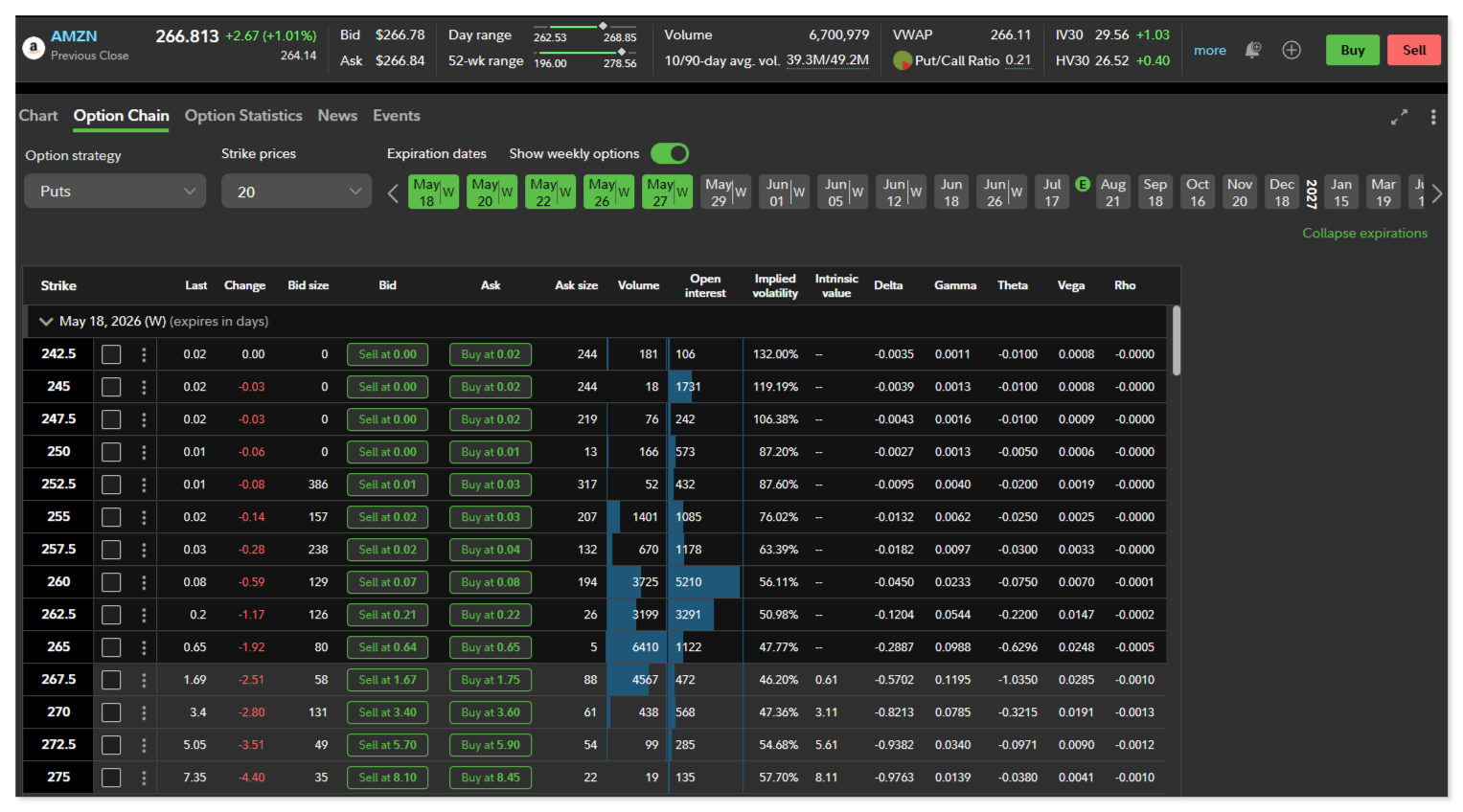
The strike price is one of the four things that define every options contract. Choose the wrong one and you can be right on direction, right on timing, and still lose money. Choose the right one and even a modest move in the stock can produce outsized returns.
This guide explains exactly what the strike price is, how it determines your profit and loss, and how to choose strikes intelligently – including how GEX data helps you identify which strikes have structural significance before you commit.
Table of Contents
- What Is a Strike Price?
- How the Strike Price Determines Profit and Loss
- In-the-Money, At-the-Money, Out-of-the-Money
- Intrinsic Value and the Strike Price
- How Strike Price Affects Delta
- How to Choose the Right Strike
- How GEX Levels Identify High-Value Strikes
- FAQ
What Is a Strike Price?

The strike price (also called the exercise price) is the fixed price at which an options contract gives you the right to buy or sell the underlying stock.
For a call option, the strike is the price at which you can buy the stock. Your call becomes profitable when the stock trades above your strike.
For a put option, the strike is the price at which you can sell the stock. Your put becomes profitable when the stock trades below your strike.
The strike price doesn’t change after you buy the contract. It’s locked in for the life of the option, regardless of where the stock goes.
Example:
You buy a SPY $545 call. The strike price is $545. That means you have the right to buy SPY at $545, no matter where SPY is actually trading – until the contract expires.
If SPY rises to $555, your $545 strike lets you buy at a $10 discount to market. That discount is your intrinsic value. If SPY stays at $542, your strike is still above the market price and the call has no intrinsic value.
How the Strike Price Determines Profit and Loss
The strike price defines your breakeven and your profit zone.
For calls
Breakeven at expiration = Strike price + Premium paid
SPY $545 call bought for $4.00 → breakeven = $549
- Below $545: Contract expires worthless, full premium lost
- $545–$549: In-the-money, but not enough to cover the premium cost
- Above $549: Profitable, and gains accelerate the further SPY goes
For puts
Breakeven at expiration = Strike price − Premium paid
SPY $535 put bought for $4.50 → breakeven = $530.50
- Above $535: Contract expires worthless, full premium lost
- $530.50–$535: In-the-money, but not enough to cover the premium
- Below $530.50: Profitable, gains accelerate the further SPY falls
In-the-Money, At-the-Money, Out-of-the-Money
The relationship between the strike price and the current stock price is called moneyness. It’s one of the most important concepts in options trading.
| Term | Call Option | Put Option |
|---|---|---|
| In-the-Money (ITM) | Strike < stock price | Strike > stock price |
| At-the-Money (ATM) | Strike ≈ stock price | Strike ≈ stock price |
| Out-of-the-Money (OTM) | Strike > stock price | Strike < stock price |
With SPY at $541:
- $535 call = ITM (can buy at $535 when market is $541 – immediate value)
- $541 call = ATM (strike equals market price)
- $548 call = OTM (strike above market – needs to rally to have value)
- $548 put = ITM (can sell at $548 when market is $541 – immediate value)
- $541 put = ATM
- $535 put = OTM (strike below market – needs to drop to have value)
Intrinsic Value and the Strike Price
Intrinsic value is the immediate, real value your option has right now based on the strike price vs. the stock price.
- ITM call intrinsic value = Stock price − Strike price
- ITM put intrinsic value = Strike price − Stock price
- OTM options have zero intrinsic value – all of their premium is extrinsic (time value)
SPY at $541, $535 call: intrinsic value = $541 − $535 = $6.00
SPY at $541, $548 call: intrinsic value = $0 (OTM)
The total premium you pay = intrinsic value + extrinsic value (time value + IV). When you buy an OTM option, you’re paying only for time value and volatility expectations – nothing that reflects current stock price vs. strike. The stock has to move enough to create intrinsic value before expiration.
How Strike Price Affects Delta
Delta – the measure of how much your option moves per $1 change in the stock – is directly tied to your strike selection.
| Strike Type | Approx. Delta (Call) | Moves $X for every $1 in stock |
|---|---|---|
| Deep ITM | 0.80–0.99 | Nearly like owning the stock |
| ATM | ~0.50 | $0.50 per $1 |
| Slightly OTM | 0.30–0.45 | $0.30–$0.45 per $1 |
| Deep OTM | 0.05–0.15 | Barely moves |
This is why deep OTM options are seductive but dangerous. A $0.30 OTM call looks cheap and has 5–10x leverage on paper – but it barely moves until the stock makes a very large move. You can be right on direction and still lose most of your premium if the move doesn’t get you close enough to the strike.
How to Choose the Right Strike
Strike selection is one of the highest-leverage decisions in options trading. Here’s the framework:
Step 1: Identify your target price and timeline
What do you think the stock will do, and by when? If you think SPY goes from $541 to $550 in the next 3 weeks, you don’t need a $560 strike – that’s too far. A $543 or $545 strike puts your target well inside the profitable zone.
Step 2: Match strike to your conviction level
- High conviction, want maximum leverage: ATM or 1–2% OTM
- Moderate conviction, want cost efficiency: Slightly ITM (built-in intrinsic value)
- Hedging or spread leg: Specific level based on strategy structure
Step 3: Check the delta
Your delta tells you how much the option moves per dollar of stock movement. For a first trade, target a delta of 0.40–0.60. That gives you meaningful participation in the move without requiring an extreme price swing.
Step 4: Verify liquidity at that strike
Check the bid-ask spread and open interest at your chosen strike. If the spread is wide and OI is thin, move to the nearest liquid strike. A tight spread saves you real money at entry and exit.
Step 5: Check GEX levels before locking in the strike
This is the step most traders skip – and it’s often the most valuable. See below.
How GEX Levels Identify High-Value Strikes

Open interest concentration at specific strikes doesn’t just affect liquidity – it creates structural price forces through dealer hedging. That’s what GEX measures.
Call walls form at strikes with massive call OI. As price approaches, dealer selling pressure creates resistance – your call strike above a call wall is harder to reach than the same distance without a wall.
Put walls form at strikes with massive put OI. In positive gamma, these are floors. In negative gamma, breaking below them accelerates the decline.
Max pain is the strike at which the most options expire worthless. As expiration nears, price gravitates there.
Practical strike selection with GEX
You’re bullish on SPY (at $541). You’re considering a $544 or a $546 strike for a 3-week call.
SweepAlgo shows a major call wall at $545 – $280M of open interest. That wall sits between your entry and both strikes.
- $544 strike: Your target is just below the wall. Price may stall exactly there.
- $546 strike: You need price to break through $280M of dealer selling to get to your strike.
A third option: the $543 strike, with your target being the call wall at $545 itself. You’re buying the move toward the wall rather than through it. This aligns the structural resistance with your profit target instead of putting it in your path.
The strike price is not just a number. It’s a position in the market’s structural landscape. GEX tells you where that landscape has walls, floors, and magnets.
FAQ
What is a strike price in simple terms?
The strike price is the fixed price at which your options contract lets you buy (call) or sell (put) a stock. It doesn’t change after you buy the contract. Your profit depends on how far the stock moves beyond your strike.
How do I choose a strike price for options?
Start by identifying your price target and timeline. Choose a strike that would be in-the-money if your target is hit, with a delta of 0.40–0.60 for most directional trades. Always verify liquidity (tight bid-ask, high open interest) and check GEX levels to avoid strikes that face heavy structural resistance.
What is the difference between strike price and stock price?
The stock price is where the stock is trading right now. The strike price is the fixed price in your options contract. The relationship between the two (moneyness) determines whether your option has intrinsic value and how likely it is to be profitable at expiration.
Does the strike price change?
No. The strike price is fixed when you buy the contract and stays the same for the entire life of the option, regardless of where the stock trades.
What happens if a stock is exactly at the strike price at expiration?
An option exactly at the strike price at expiration is at-the-money and has zero intrinsic value. For a call, you’d need the stock to be above the strike (plus premium) to profit. Being exactly at the strike at expiration means you lose the premium.
Why do some strikes have higher open interest than others?
Institutional and retail positioning naturally clusters at round numbers and technically significant levels. Strikes at clean round numbers ($540, $545, $550 on SPY) tend to have much higher OI than strikes at irregular levels. That OI concentration creates GEX levels – real structural forces – that influence price behavior near those strikes.
The Bottom Line
The strike price determines your breakeven, your delta, your intrinsic value, and how much the stock needs to move for your trade to work. Choosing it isn’t arbitrary – it’s a function of your target, your conviction, the contract’s liquidity, and where the structural forces in the market (GEX levels) make the trade easier or harder.
See GEX levels and structural strike analysis for SPY, SPX, and QQQ on SweepAlgo →
Disclaimer: This content is for educational purposes only and does not constitute financial advice. Options trading involves substantial risk of loss and is not appropriate for all investors.