

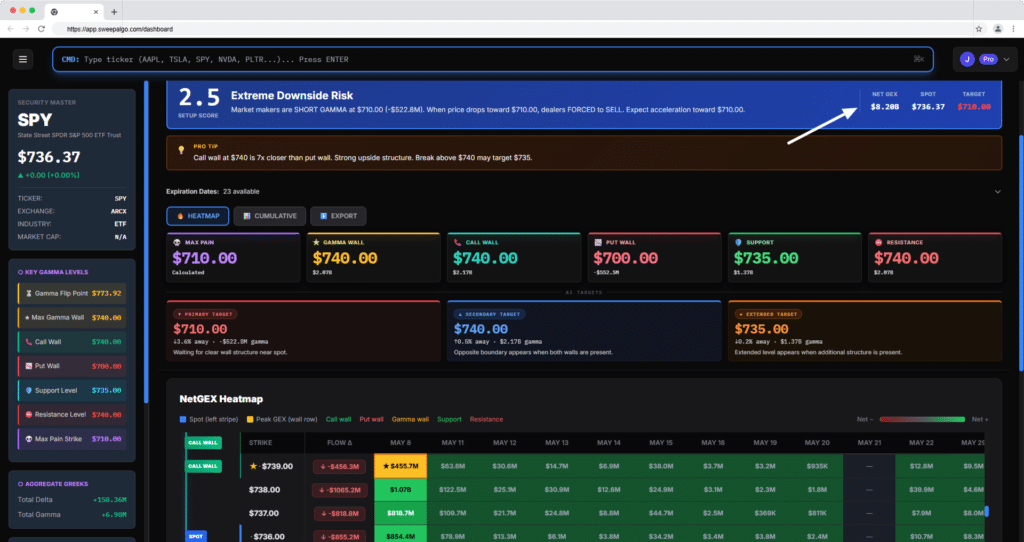
If you’ve spent any time researching gamma exposure, you’ve seen the term “Net GEX” thrown around, usually next to a number measured in billions of dollars. Most explanations either skip over what it actually means or bury it in options math.
This is the clean version. Here’s exactly what Net GEX is, what the number tells you, and how to use it before you place a trade.
Net GEX: The One-Line Definition
Net GEX (Net Gamma Exposure) is the total dollar value of stock that options dealers would need to buy or sell to stay delta-neutral if the underlying moves by 1%.
It’s measured in dollars, typically millions or billions for index products like SPY and SPX. A positive number means dealers are net long gamma. A negative number means they’re net short gamma.
That’s it. Everything else flows from that.
Related: Positive vs Negative Gamma: How to Adjust Your Strategy for Each Environment
How Net GEX Is Calculated
Without getting into full options math, here’s the intuition:
For every options contract outstanding, dealers have a gamma position based on whether they bought or sold the contract and what type it is. The formula aggregates that across all strikes and expirations:
Net GEX = Σ (Gamma × Open Interest × Contract Size × Spot Price²) × Dealer Sign
The “dealer sign” is the key, it adjusts for whether dealers are long or short each contract type. Dealers are typically short calls and long puts (or the reverse), so their net gamma position is the aggregate across the entire options chain.
You don’t need to calculate this. GEX tools do it automatically. But understanding the formula helps you know what you’re looking at.
Related: What Is a Gamma Wall? How Options Dealers Create Price Ceilings
Reading the Net GEX Number
Positive Net GEX
When Net GEX is a large positive number, say, +$3.5 billion, dealers are heavily long gamma. Their hedging flows dampen volatility. This is a stable, mean-reverting market environment.
The larger the positive number, the stronger the dampening effect. A $5B positive GEX day on SPX means dealers are selling enormous amounts of stock into every rally and buying into every dip. Price is pinned.
Negative Net GEX
When Net GEX turns negative, say, -$1.2 billion, dealers are net short gamma. Their hedging flows amplify volatility. This is a trending, high-volatility environment.
Negative GEX is associated with large intraday moves, VIX spikes, and days where nothing “works” technically because price keeps moving through levels that should hold.
Near Zero
When Net GEX is near zero, the market is at a transition point, close to the gamma flip level. This is often an unstable zone where direction hasn’t been established. Small catalysts can push it either way.
Net GEX vs Strike-Level GEX: What’s the Difference?
This is where people get confused.
Net GEX is the single aggregate number for the entire market (or a specific ticker). It tells you the overall dealer positioning regime.
Strike-level GEX is the gamma exposure at each individual strike price. This is what shows up on a GEX heatmap, green bars (positive GEX) and red bars (negative GEX) at each strike across the options chain.
Both matter, but they answer different questions:
| Net GEX | Strike-Level GEX | |
|---|---|---|
| Answers | What regime am I in? | Where are the specific friction levels? |
| Displayed as | Single dollar figure | Heatmap across strikes |
| Used for | Setting overall strategy | Finding specific entry/exit levels |
| Example | “+$2.1B, positive gamma, stable market” | “$560 = gamma wall, $540 = gamma flip” |
Related: How to Read a GEX Heatmap Step by Step
How Net GEX Changes Through the Week
Net GEX isn’t static. It shifts as:
- New options are bought and sold, each trade changes dealer positioning
- Price moves, as price approaches different strikes, the aggregate gamma changes
- Options expire, each expiration removes gamma from the market, often causing a GEX reset
The most significant GEX shifts happen around:
- Monday open, new weekly options are priced, gamma resets
- Wednesday–Thursday, heavy 0DTE activity builds up at near-term strikes
- OpEx Friday, gamma expires, the slate is wiped, the next week’s regime starts fresh
Understanding this weekly cycle helps you interpret Net GEX in context. A +$2B reading on a Monday is different from a +$2B reading on Thursday, the Thursday reading is more likely to flip quickly as expiration approaches.
Related: OPEX Week Trading Strategy: How to Trade Options Expiration With GEX
How SweepAlgo Displays Net GEX
On SweepAlgo’s dashboard, you get Net GEX displayed in two ways:
- The AI Analysis panel, gives you the Net GEX dollar figure alongside a plain-English interpretation: “NET GEX: +$1.2B, Market makers are LONG GAMMA at $275.00.”
- The NetGEX Heatmap, shows the strike-level GEX breakdown across all expirations, color-coded green (positive) and red (negative) so you can see both the aggregate positioning and the specific friction levels at a glance.

ALT: SweepAlgo NetGEX heatmap for SPY showing green positive gamma strikes above spot and red negative gamma strikes below the gamma flip level
See the live Net GEX reading for SPY →
The Quick Reference: What to Do With the Net GEX Number
| Net GEX Reading | Regime | Strategy |
|---|---|---|
| Large positive (+$2B+) | Strongly positive gamma | Sell premium, fade extremes, expect range |
| Moderate positive (+$500M to +$2B) | Positive gamma | Mean-reversion bias, respect gamma wall |
| Near zero (±$500M) | Transition zone | Caution, wait for direction confirmation |
| Moderate negative (-$500M to -$2B) | Negative gamma | Momentum bias, wider stops, follow the trend |
| Large negative (-$2B+) | Strongly negative gamma | Elevated vol, trend trades only, long premium |
The Bottom Line
Net GEX is the single number that tells you what kind of market you’re trading before you look at a single candle. It doesn’t tell you which direction price will go, but it tells you how it will behave when it moves, and that changes everything about how you should trade it.
Related: Gamma Flip Levels Explained: How to Trade the Most Powerful Level in the Market