

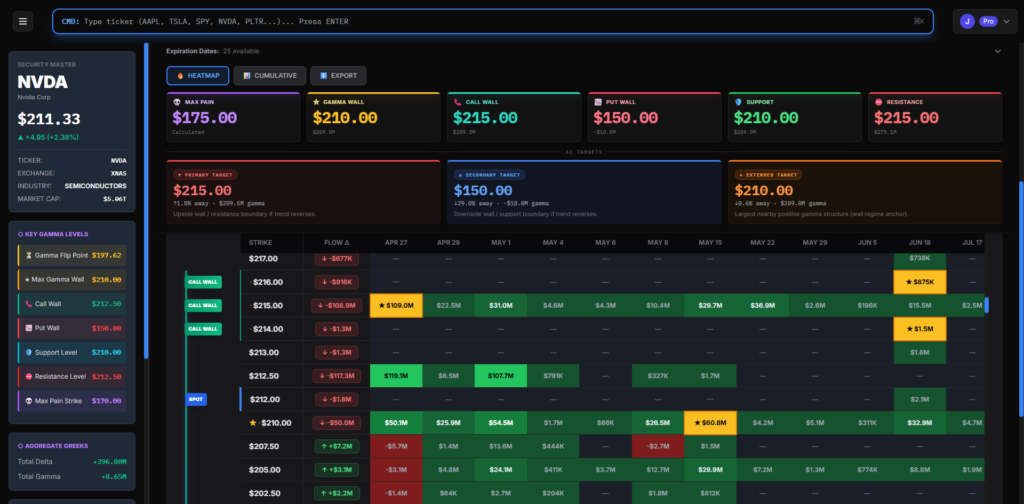
Gamma exposure (GEX) is one of the most important concepts in options trading, yet most retail traders completely ignore it.
If you trade SPX, SPY, or QQQ, understanding gamma exposure can help you identify:
- Key support and resistance levels
- Market volatility conditions
- Dealer positioning and hedging behavior
In this guide, you’ll learn exactly what gamma exposure is, how it works, and how traders use GEX levels to understand market movements.
What is Gamma Exposure (GEX)?
Gamma exposure (GEX) measures the total gamma of all options positions in the market.
In simple terms:
👉 Gamma exposure shows how market makers (dealers) are positioned and how they may need to hedge as price moves.
Because dealers dynamically hedge their positions, gamma exposure plays a direct role in how price moves in assets like SPX, SPY, and QQQ.
How Gamma Exposure Works
To understand gamma exposure, you need to understand how dealers manage risk.
When traders buy options, dealers take the opposite side of the trade.
For example:
- A trader buys call options
- The dealer sells those calls
Now the dealer is exposed to risk if price rises.
Dealer Hedging Explained
To manage that risk, dealers hedge by buying or selling the underlying asset.
As price changes:
- The dealer’s delta changes
- They must adjust their hedge
- That adjustment is driven by gamma
👉 Gamma exposure determines how aggressive that hedging becomes.
Positive vs Negative Gamma Exposure
Gamma exposure can be either positive or negative, and this determines how the market behaves.
Positive Gamma (Low Volatility)
When gamma exposure is positive:
- Dealers hedge against price movement
- If price rises → dealers sell
- If price falls → dealers buy
This creates:
- Lower volatility
- Range-bound conditions
- Price pinning near key levels
Negative Gamma (High Volatility)
When gamma exposure is negative:
- Dealers hedge with price movement
- If price rises → dealers buy
- If price falls → dealers sell
This leads to:
- Increased volatility
- Stronger trends
- Faster price movements
👉 This is why gamma exposure is critical for understanding market conditions.
What is a Gamma Flip Level?
The gamma flip level is where gamma exposure shifts from positive to negative.
This is one of the most important GEX levels traders watch.
Why Gamma Flip Matters
- Above the gamma flip → markets tend to stabilize
- Below the gamma flip → volatility increases
Traders use the gamma flip level to anticipate:
- Market regime changes
- Breakouts
- Volatility expansion
Call Walls and Put Walls Explained
Gamma exposure also helps identify key levels known as call walls and put walls.
What is a Call Wall?
A call wall is a strike price with a large concentration of call options.
Because dealers are often short these calls:
- They hedge by selling as price rises
- This can create resistance
👉 Call walls often act as resistance levels in the market.
What is a Put Wall?
A put wall is a strike with heavy put option positioning.
Dealers hedge by buying as price falls.
👉 This creates support.
Why These Levels Matter
Call walls and put walls are important because they represent areas where dealer hedging can influence price.
Why Markets Pin to Certain Levels
One of the most common questions traders ask is:
👉 Why does price stay stuck at certain levels?
The answer is gamma exposure.
When large options positions exist at a strike:
- Dealers hedge around that level
- Price is pulled toward it
This creates a phenomenon known as:
👉 options pinning
How Traders Use Gamma Exposure
Professional traders use gamma exposure to:
- Identify key levels (GEX levels)
- Understand dealer positioning
- Anticipate volatility
- Avoid false breakouts
Instead of relying only on technical indicators, traders combine:
- Gamma exposure
- Options flow
- Price action
Gamma Exposure vs Technical Analysis
Technical analysis focuses on past price data.
Gamma exposure focuses on:
👉 Current market positioning
This gives traders an edge because:
- It reflects real-time risk
- It shows where pressure exists
- It helps anticipate reactions
Can Gamma Exposure Predict the Market?
Gamma exposure does not predict exact direction.
However, it helps traders:
- Identify high-probability zones
- Understand volatility conditions
- Anticipate where price may react
👉 It provides context, not certainty.
Why Gamma Exposure Matters for SPX, SPY, and QQQ
Gamma exposure is especially important for index trading.
Because:
- SPX and SPY have massive options volume
- Dealer hedging is significant
- GEX levels influence intraday movement
👉 This is why many traders track SPX gamma exposure daily.
How to Track Gamma Exposure in Real Time
To effectively use gamma exposure, traders need access to real-time data.
This includes:
- Net GEX
- Gamma flip levels
- Call walls and put walls
- Dealer positioning
Tools like SweepAlgo allow traders to visualize gamma exposure and understand how the market is positioned.
Final Thoughts on Gamma Exposure
Gamma exposure is one of the most powerful concepts in modern options trading.
It explains:
- Why markets move
- Where price reacts
- When volatility increases
If you understand gamma exposure, you are no longer guessing.
👉 You are trading with structure.
🚀 Track Gamma Exposure in Real Time
👉 Use our Gamma Exposure Tool to monitor GEX levels, dealer positioning, and key options levels across SPX, SPY, and QQQ.