
If you’ve ever watched the market and thought:
- Why did price reverse at that exact level?
- Why does SPY get stuck in a tight range for hours?
- Why do some breakouts fail instantly while others explode?
The answer is often not technical indicators, news, or sentiment.
👉 It’s gamma exposure (GEX).
Most retail traders focus on price.
Professional traders focus on positioning — and gamma exposure is one of the most important forces behind it.
This guide will show you not just what gamma exposure is, but how it actually moves the market in real time.
What is Gamma Exposure (GEX)?
Gamma exposure (GEX) measures how options market makers (dealers) are positioned and how they adjust their hedges as price moves.
In simple terms:
👉 Gamma exposure shows how much buying or selling pressure dealers may create as the market moves.
Breaking It Down
- Delta = how much an option moves with price
- Gamma = how fast delta changes
- Gamma Exposure (GEX) = total gamma across all options positions
👉 When gamma changes, dealer hedging changes
👉 When hedging changes, price behavior changes
Who Are Dealers and Why Do They Matter?
When traders buy options, someone has to sell them.
That “someone” is usually a market maker (dealer).
Their goal is not to speculate.
👉 Their goal is to stay neutral and manage risk.
Example
- A trader buys call options
- The dealer sells those calls
- Now the dealer is exposed to upside risk
To manage that risk:
👉 The dealer hedges by buying or selling the underlying stock
👉 This hedging activity is one of the biggest drivers of price movement.
Positive vs Negative Gamma (The Core Mechanism)
🟢 Positive Gamma (Market Stabilization)
When dealers are in positive gamma:
- If price goes UP → dealers SELL
- If price goes DOWN → dealers BUY
👉 They are fighting the move
Result:
- Lower volatility
- Range-bound price action
- Markets feel controlled
🔴 Negative Gamma (Market Acceleration)
When dealers are in negative gamma:
- If price goes UP → dealers BUY
- If price goes DOWN → dealers SELL
👉 They are amplifying the move
Result:
- Higher volatility
- Strong trends
- Fast directional moves
👉 This is why some days feel slow and others explosive
What is a Gamma Flip Level?
The gamma flip is the price level where the market shifts from:
👉 Positive gamma → Negative gamma
Why It Matters
- Above the flip → stable, controlled market
- Below the flip → volatile, fast-moving market
👉 This level acts as a switch in market behavior
Call Walls and Put Walls Explained
📈 Call Wall (Resistance)
A call wall is a strike price with heavy call option positioning.
Dealers who sold those calls:
👉 Are short calls
👉 Are exposed to upside risk
As price approaches that level:
👉 Dealers hedge by selling stock
Result:
👉 Price often struggles to break above it
📉 Put Wall (Support)
A put wall is a strike price with heavy put option positioning.
Dealers hedge by buying as price falls.
Result:
👉 Price often finds support
Why Markets “Pin” to Certain Levels
When large options positions exist at a strike:
👉 Dealers continuously hedge around that level
This creates:
👉 A magnet effect
👉 Price gets pulled toward that strike
👉 This is known as options pinning
🔥 Real Gamma Exposure Example (Dashboard Breakdown)
Let’s break down a real gamma exposure setup using a dashboard.
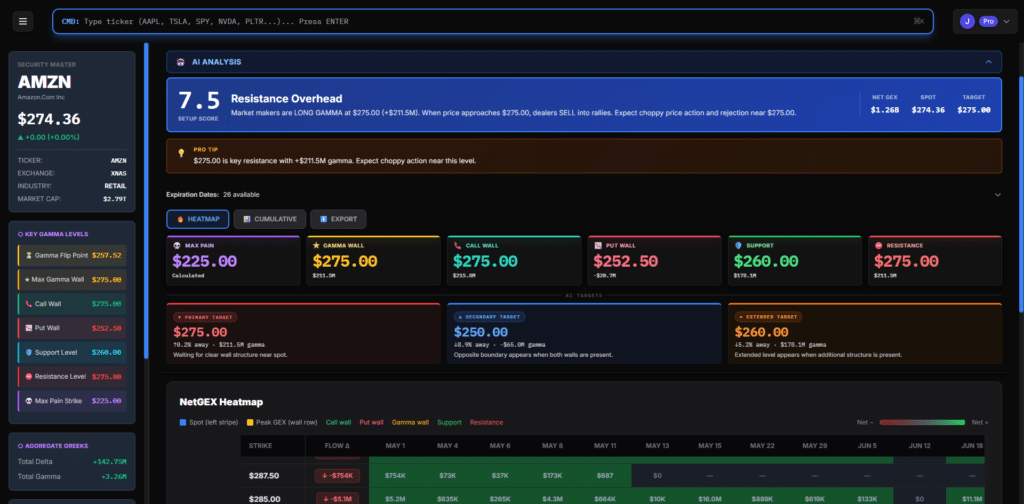
Setup Overview
- Net GEX: $1.26B
- Gamma Flip: ~$275
- Call Wall: $275
- Put Wall: $252.50
- Resistance: $275
- Support: $260
What This Means
1. Positive Gamma Environment
👉 Dealers are long gamma
- They sell into rallies
- They buy into dips
Result:
👉 Price becomes choppy and controlled
2. Call Wall at $275
👉 Heavy call positioning
- Dealers hedge by selling
- Price struggles to break above
👉 This creates strong resistance
3. Put Wall at $252.50
👉 Downside support
- Dealers hedge by buying
- Price likely to bounce
4. Gamma Flip at $275
👉 Critical transition zone
- Above → stable
- Below → volatility increases
5. Heatmap Insight
The gamma heatmap shows:
- where positioning is concentrated
- where liquidity exists
- where price is likely to react
👉 This is how professionals identify key levels
Key Insight
Most traders see:
👉 “Resistance at $275”
But gamma exposure explains:
👉 WHY that resistance exists
How Gamma Exposure Impacts SPX, SPY, and QQQ
Gamma exposure is especially important for index trading.
Why?
- Massive options volume
- High dealer participation
- Strong hedging impact
👉 This is why SPX and SPY often respect GEX levels intraday
How to Trade Using Gamma Exposure
Simple Framework
1. Identify Gamma Flip
👉 Defines market condition
2. Watch Call Walls
👉 Resistance zones
3. Watch Put Walls
👉 Support zones
4. Observe Price Reaction
👉 Trade reaction, not prediction
Example Scenarios
Scenario 1: Price below gamma flip
👉 Expect volatility
Scenario 2: Price near call wall
👉 Expect rejection
Scenario 3: Price near put wall
👉 Expect bounce
Gamma Exposure vs Technical Analysis
Most indicators:
- lag price
- react after movement
Gamma exposure:
👉 reflects real positioning
👉 shows underlying pressure
👉 explains price behavior
Why Most Traders Lose
Most traders:
- ignore options positioning
- chase breakouts
- trade without context
👉 They react instead of understanding
Gamma Exposure FAQ
What is gamma exposure in simple terms?
Gamma exposure measures how dealer hedging may impact price as the market moves.
What is a gamma flip level?
The gamma flip is where the market shifts from stable to volatile conditions.
What is a call wall?
A call wall is a level where heavy call positioning creates resistance.
What is a put wall?
A put wall is a level where heavy put positioning creates support.
Does gamma exposure predict price?
No — but it helps identify where price is likely to react.
How to Track Gamma Exposure in Real Time
To use gamma exposure effectively, traders need:
- Net GEX
- Gamma flip levels
- Call walls and put walls
- Dealer positioning
🚀 Track Gamma Exposure with SweepAlgo
With SweepAlgo, you can:
- See real-time gamma exposure
- Identify key levels instantly
- Understand dealer positioning
- Trade with structure instead of guesswork
👉 Use the Gamma Exposure Tool to see these levels in real time
Final Thoughts
Gamma exposure is one of the most powerful concepts in modern trading.
It explains:
- Why markets move
- Where price reacts
- When volatility expands
If you understand gamma exposure:
👉 You stop reacting
👉 You start anticipating