

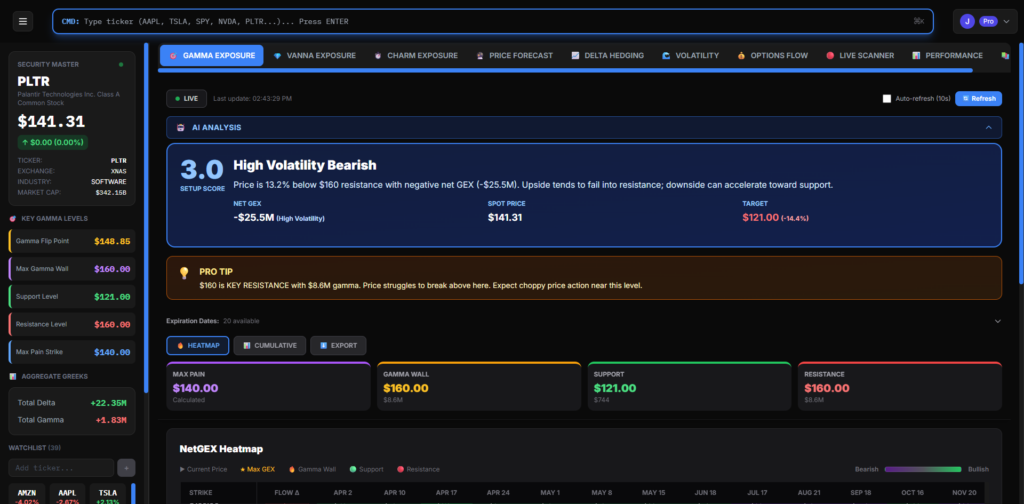
Gamma exposure analysis reveals Palantir Technologies (PLTR) is trading in a high-volatility bearish environment with -$25.5M net gamma exposure according to SweepAlgo.com.
At $141.31, PLTR sits 13.2% below the critical $160 resistance level where $8.6M in gamma exposure creates a massive ceiling.
This comprehensive analysis uses real-time gamma exposure data from SweptAlgo.com to identify:
- Why PLTR’s negative gamma amplifies volatility
- Key price levels where market makers must hedge
- Trading strategies for high-volatility environments
- How the $160 gamma wall blocks upside momentum
- Support zones that could trigger accelerated selling
Understanding gamma exposure transforms how you trade PLTR, revealing the invisible forces moving this stock beyond fundamental analysis.
What Is Gamma Exposure?
Gamma exposure (GEX) measures how much options market makers must buy or sell stock as prices move.
It’s one of the most powerful yet misunderstood forces driving modern stock price movements.
How Gamma Exposure Works
When you buy a PLTR call option, a market maker sells it to you and immediately hedges by buying PLTR shares.
As PLTR’s price moves, the option’s delta changes based on gamma. This forces market makers to constantly adjust their stock holdings.
The mechanical process:
- Retail trader buys PLTR call option
- Market maker sells call (becomes short the option)
- Market maker buys PLTR shares to hedge delta risk
- Stock price changes → gamma determines new hedge amount
- Market maker buying/selling creates price pressure
SweptAlgo.com calculates aggregate gamma exposure across all strikes and expirations, showing exactly where hedging pressure concentrates.
Positive vs Negative Gamma Exposure
The sign of gamma exposure determines whether market maker hedging stabilizes or destabilizes prices.
Positive Gamma Exposure:
When net GEX is positive, market makers are net short options.
- Hedging behavior: Buy dips, sell rallies
- Price effect: Dampens volatility, creates range-bound trading
- Best for: Premium selling strategies, iron condors
- Market character: Choppy, mean-reverting price action
Negative Gamma Exposure:
When net GEX is negative, market makers are net long options.
- Hedging behavior: Sell dips, buy rallies
- Price effect: Amplifies momentum in both directions
- Best for: Directional trades, trend following
- Market character: Explosive moves, high volatility
PLTR’s current situation: With -$25.5M net gamma exposure, PLTR operates in a negative gamma regime where moves accelerate quickly.
PLTR Gamma Exposure Profile
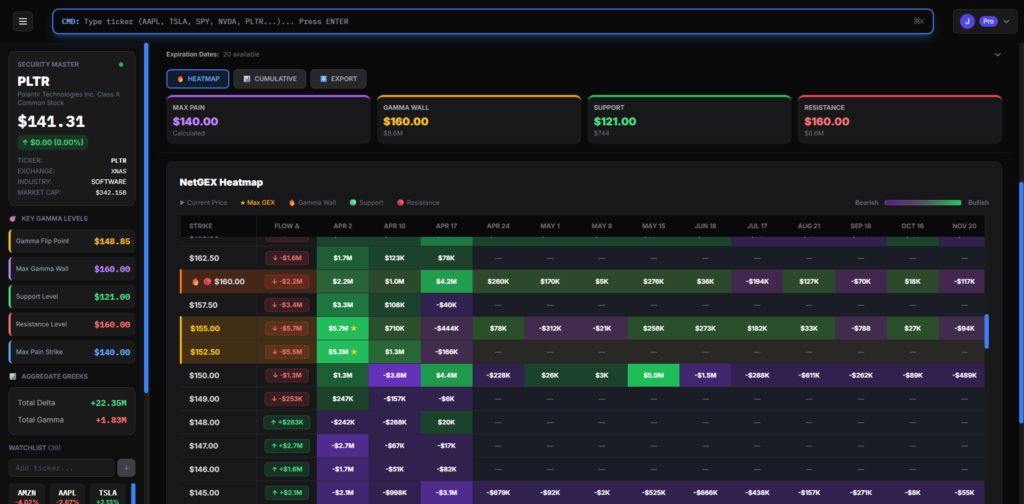
Let’s analyze Palantir’s specific gamma exposure setup using SweepAlgo.com data.
Key PLTR Gamma Exposure Metrics
SweptAlgo.com reveals the following critical levels for PLTR:
Current Price Action:
- Spot price: $141.31
- Ticker: PLTR
- Exchange: XNAS (Nasdaq)
- Industry: Software
- Market cap: $342.15B
Gamma Exposure Levels:
- Net GEX: -$25.5M (High Volatility indicator)
- Gamma Flip Point: $148.85
- Max Gamma Wall: $160.00 ($8.6M concentration)
- Support Level: $121.00 ($744 exposure)
- Resistance Level: $160.00 ($8.6M exposure)
Market Regime: 3.0 Setup Score – “High Volatility Bearish”
Aggregate Greeks:
- Total Delta: +22.35M
- Total Gamma: +1.63M
Understanding PLTR’s High Volatility Bearish Setup
The AI analysis from SweptAlgo.com provides crucial context:
Setup Score 3.0 means: “Price is 13.2% below $160 resistance with negative net GEX (-$25.5M). Upside tends to fail into resistance; downside can accelerate toward support.”
What this bearish gamma profile tells us:
- $160 resistance is formidable – $8.6M gamma wall creates ceiling
- Current price vulnerable – Trading well below resistance at $141.31
- Negative gamma amplifies moves – Market maker hedging works with momentum
- Support at $121 – Next major level if selling accelerates
Pro Tip from SweptAlgo.com: “$160 is KEY RESISTANCE with $8.6M gamma. Price struggles to break above here. Expect choppy price action near this level.”
This is classic negative gamma exposure behavior—rallies fail at resistance while dips can accelerate.
Strike-by-Strike Gamma Analysis
The SweptAlgo.com heatmap reveals concentrated gamma exposure at specific strikes:
Critical Strikes:
$160.00 Strike (Maximum Resistance):
- Gamma concentration: $8.6M
- Significance: Heaviest gamma wall in entire chain
- Trading implication: Acts as strong price ceiling
- Distance from spot: 13.2% above current price
- Pattern: Multiple expirations showing heavy activity
$155.00 Strike:
- Net GEX: Moderate concentration visible in heatmap
- Significance: Intermediate resistance zone
- Price action: Secondary barrier before $160
$150.00 Strike:
- Net GEX: Positive gamma visible
- Significance: Psychological level near gamma flip point
- Trading note: Key zone for regime change
$148.85 Strike (Gamma Flip Point):
- Net GEX: Transition from negative to positive
- Significance: Where market dynamics fundamentally shift
- Trading implication: Break above changes entire setup
- Watch for: Price action around this critical level
$141.31 Strike (Current Spot Price):
- Position: In negative gamma territory
- Net GEX: -$25.5M aggregate
- Environment: High volatility, momentum amplification
- Risk: Moves can accelerate without warning
$121.00 Strike (Support Level):
- Gamma exposure: $744
- Significance: First major support below current price
- Trading implication: Critical stop-loss level
- Risk if broken: Accelerated selling into next gamma level
$140.00 Strike (Max Pain):
- Calculated level: Where option sellers profit most
- Gamma behavior: Moderate concentration
- Significance: Natural gravitational pull for expiration
The $160 Gamma Wall Explained
The $160 strike represents what traders call a “gamma wall”—a price level with such concentrated gamma exposure that it creates powerful resistance.
Why $160 matters for PLTR:
At this strike, market makers have $8.6M in gamma exposure according to SweptAlgo.com.
As PLTR approaches $160, the hedging required becomes enormous.
Mechanics of the $160 wall:
- Massive call options sold at $160 strike
- Market makers short these calls
- As price rises toward $160, delta increases
- Market makers must sell PLTR shares to hedge
- Their selling creates resistance preventing breakout
Historical context:
PLTR has tested this $160 zone multiple times but failed to sustain breakouts. The gamma exposure concentration explains why—mechanical selling pressure overwhelms buying.
Trading implications:
- Take profits on longs near $158-$160
- Short positions with tight stops above $162
- Options sellers can use $160 as ceiling for credit spreads
- Breakout traders need confirmation above $165
The $160 gamma wall isn’t permanent, but it requires significant buying volume to overcome the hedging flows.
How PLTR’s Negative Gamma Exposure Creates Volatility
With -$25.5M net gamma exposure, PLTR operates in an environment where market maker hedging amplifies price movements.
Volatility Amplification Mechanics
In negative gamma environments like PLTR:
When PLTR rises:
- Market makers are long puts or short calls
- Their delta position becomes too short
- They must BUY shares to rebalance
- Their buying pushes price higher
- Creating momentum in direction of move
When PLTR falls:
- Market makers’ delta becomes too long
- They must SELL shares to rebalance
- Their selling accelerates the decline
- Creating momentum cascade downward
This creates the “High Volatility” designation on SweptAlgo.com.
Real-World PLTR Examples
Looking at the gamma exposure heatmap from SweptAlgo:
Scenario 1: Rally Attempt
If PLTR rallies from $141 toward $148.85 (gamma flip):
- Negative gamma amplifies upside initially
- Market makers forced to buy into strength
- Momentum builds toward flip point
- But $160 wall still creates ceiling
- Rally likely fails unless volume massive
Scenario 2: Breakdown Below Support
If PLTR breaks below $121 support:
- Enters deeper negative gamma zone
- Market makers forced to sell into weakness
- Accelerated decline to next support level
- Panic selling risk increases
- Bounce only at extreme oversold levels
Scenario 3: Grind Higher to Gamma Flip
If PLTR grinds to $148.85 and breaks through:
- Flips to positive gamma environment
- Market maker hedging switches to stabilizing
- Volatility compresses significantly
- Range-bound trading more likely
- But still faces $160 wall above
Comparing PLTR to Other High-Vol Stocks
PLTR’s -$25.5M gamma exposure places it in the “high volatility” category alongside other momentum stocks.
Typical gamma profiles by stock type:
- Index ETFs (SPY, QQQ): Usually positive gamma, stable
- Mega-cap tech (AAPL, MSFT): Mixed, generally stable
- Growth stocks (PLTR, NVDA): Often negative, volatile
- Meme stocks (GME, AMC): Extreme negative during squeezes
PLTR’s software industry and institutional ownership creates active options trading, leading to frequent negative gamma setups.
Trading PLTR’s Negative Gamma Environment
Understanding PLTR’s gamma exposure enables strategic trading decisions.
What PLTR’s Gamma Exposure Means for Traders
With -$25.5M net gamma exposure, expect these characteristics:
Volatility characteristics:
- Larger-than-normal intraday swings (3-5%+)
- Momentum that accelerates quickly
- Sharp reversals that fail to hold
- Trending behavior rather than range-bound
- Gap risk elevated on news or events
Key trading levels from gamma analysis:
- Resistance: $160.00 (gamma wall – very difficult to break)
- Gamma Flip: $148.85 (regime change if exceeded)
- Current: $141.31 (in negative gamma danger zone)
- Support: $121.00 (critical level, break = acceleration)
- Target: $121.00 (-14.4% from current per SweptAlgo AI)
Directional Trading Strategies
For bullish traders:
Long Call Options:
- Buy $145 or $150 calls expiring 2-4 weeks out
- Leverage negative gamma amplifying upside
- Target: $148.85 gamma flip point or $155 resistance
- Stop loss: Below $138 or on break of $140 support
- Risk: Premium paid, volatility crush if stalls
Bull Put Spreads:
- Sell $135 put / Buy $130 put
- Collect premium in high volatility environment
- Support at $121 provides cushion
- Max profit if PLTR stays above $135
- Defined risk = spread width
Stock Swing Trade:
- Enter on dips toward $138-$140
- Stop loss: Below $137
- First target: $148.85 gamma flip
- Second target: $155-$158 (before $160 wall)
- Use tight trailing stops in negative gamma
For bearish traders:
Long Put Options:
- Buy $140 or $135 puts expiring 2-4 weeks
- Negative gamma amplifies downside moves
- Target: $121 support level
- Stop loss: Above $145 or gamma flip at $148.85
- Risk: Premium paid
Bear Call Spreads:
- Sell $155 call / Buy $160 call
- Profit from $160 gamma wall resistance
- High probability in negative gamma regime
- Max profit if PLTR stays below $155 at expiration
- Risk defined by $5 spread width
Short Stock (Advanced):
- Short near $145-$148 resistance
- Stop loss: Above $148.85 gamma flip
- Target: $121 support
- Risk: Unlimited, use tight stops
- Only for experienced traders
Range Trading Around Gamma Flip Point
The $148.85 gamma flip point creates interesting trading opportunities.
Range strategy:
- Buy PLTR near $140-$142 (current area)
- Sell near $148-$148.85 (approaching flip)
- Stop loss: Below $138
- Rationale: Gamma flip acts as magnet and ceiling
- Time frame: Days to weeks
Why this works:
Below $148.85: Negative gamma creates volatility
Above $148.85: Positive gamma dampens moves
Price tends to gravitate toward flip point, creating predictable patterns.
Options Strategies for High Volatility
PLTR’s negative gamma exposure creates premium opportunities.
Iron Condor (Defined Risk):
- Sell $135 put / Buy $130 put
- Sell $155 call / Buy $160 call
- Collect premium from high implied volatility
- Profit if PLTR stays between $135-$155
- Max risk: Spread width minus credit
- Best case: Volatility compresses, options decay
Short Straddle (Unlimited Risk):
- Sell $142 call AND $142 put
- Collect massive premium from volatility
- Profit if PLTR stays near $142
- Requires margin and experience
- Risk: Unlimited in both directions
- Management: Adjust as price moves
Calendar Spread (Time Decay):
- Sell near-term $145 call
- Buy longer-term $145 call (same strike)
- Profit from faster near-term decay
- Negative gamma in front month decays quickly
- Max profit: Front month expires worthless
- Risk: Limited to debit paid
Broken Wing Butterfly:
- Buy 1 $135 put
- Sell 2 $140 puts
- Buy 1 $142 put (closer to spot)
- Directional bias with limited risk
- Profit from move toward $140
- Max risk: Defined by structure
Position Sizing for Negative Gamma
Standard position sizing rules don’t apply in negative gamma exposure environments.
Reduce normal position sizes by 30-50% because:
- Volatility spikes happen without warning
- Moves amplify faster than normal stocks
- Gap risk elevated overnight
- Stop losses can get blown through
- Mental capital drain from big swings
Example position sizing:
Normal portfolio allocation: 5% in one stock
PLTR in negative gamma: 2-3% maximum
Normal options allocation: 2% risk per trade
PLTR options: 1% risk per trade
This protects capital during unexpected volatility expansion.
Stop Loss Placement Using Gamma Levels
SweptAlgo.com gamma levels provide logical stop-loss points.
For long positions:
- Aggressive stop: $138 (2% below current)
- Moderate stop: $135 (5% below current)
- Conservative stop: $120.50 (below $121 support)
Rationale:
$121 support holds meaningful gamma exposure. Breaking it triggers mechanical selling from market maker hedging. Better to exit before that level.
For short positions:
- Aggressive stop: $145 (3% above current)
- Moderate stop: $148.85 (gamma flip point)
- Conservative stop: $152 (well above flip)
Rationale:
Breaking above $148.85 flips gamma positive, changing entire market structure. Shorts should exit before regime change.
How PLTR Gamma Exposure Changes Over Time
Gamma exposure isn’t static—it evolves constantly based on options activity and price movement.
Gamma Flip Scenarios
The $148.85 gamma flip point represents where PLTR transitions from negative to positive gamma.
If PLTR rises above $148.85:
- Net gamma flips positive
- Market maker hedging switches to stabilizing
- Volatility compresses significantly
- Range-bound trading becomes more likely
- Still faces $160 gamma wall resistance
If PLTR falls below current levels:
- Enters deeper negative gamma territory
- Selling accelerates from market maker hedging
- Next support at $121 becomes critical
- Panic selling risk increases
- Bounce opportunities at extreme oversold
Monitoring the flip:
Watch SweptAlgo.com for:
- Heavy call buying above $148
- Put sellers closing positions
- Declining implied volatility
- Price stabilization above $148.85 for 2+ days
Options Expiration Effects
Gamma exposure changes dramatically around expiration dates.
PLTR expiration dynamics:
SweptAlgo.com shows “20 available” expirations, including:
- 0DTE (zero days to expiration) options
- Weekly expirations (every Friday)
- Monthly expirations (third Friday)
- LEAPS (long-term)
Expiration week pattern:
- Monday-Wednesday: Traders begin closing positions
- Thursday: Peak adjustment activity, gamma shifts
- Friday: Final settlement, old gamma expires
- Following Monday: New gamma profile emerges
Trading around PLTR expirations:
- Avoid holding short options into Friday
- Gamma can flip dramatically post-expiration
- Price often “pins” to max pain ($140 currently)
- Volatility expansion Thursday/Friday common
News Catalysts and Gamma Interaction
PLTR’s negative gamma exposure magnifies reactions to news events.
Upcoming catalysts to monitor:
Company-specific:
- Quarterly earnings reports
- Government contract announcements
- Product releases (AIP, Foundry updates)
- Insider buying/selling activity
- Analyst upgrades/downgrades
Sector-wide:
- AI regulation developments
- Defense spending bills
- Big tech earnings (sentiment spillover)
- Economic data (GDP, inflation)
- Fed interest rate decisions
How negative gamma amplifies news:
Positive news example:
- PLTR announces major government contract
- Stock gaps up 5% to $148
- Market makers short calls forced to buy shares
- Their buying pushes PLTR to $150+
- Negative gamma amplified 5% move to 8-10%
Negative news example:
- Earnings miss expectations
- Stock drops 3% to $137
- Market makers long puts forced to sell shares
- Their selling accelerates decline to $130
- Negative gamma amplified 3% drop to 8-10%
Trading around events:
- Close positions before high-impact events
- Use options for defined-risk directional plays
- Expect volatility expansion, not contraction
- Gamma amplification works both ways
Comparing PLTR to Broader Market Gamma
Understanding how PLTR’s gamma exposure compares to indices provides important context.
PLTR vs SPY Gamma Profiles
SPY (S&P 500 ETF):
- Typically positive gamma in stable markets
- Massive options volume creates deep liquidity
- 0DTE options now 40%+ of SPY volume
- Gamma walls common at round numbers
PLTR (Individual Stock):
- Currently negative gamma (-$25.5M)
- Less liquid than major indices
- More vulnerable to gamma flips
- Specific to company news and sector rotation
Implications:
When SPY has positive gamma but PLTR has negative:
- Broader market stability doesn’t help PLTR
- Stock-specific dynamics dominate
- Sector rotation can intensify PLTR moves
- Diversification provides limited protection
Software Sector Gamma Analysis
PLTR operates in the software sector alongside other growth stocks.
Software sector gamma characteristics:
High-growth software stocks often display:
- Negative gamma exposure during rallies
- Extreme volatility around earnings
- Heavy options activity from retail and institutions
- Gamma squeezes during momentum moves
Similar gamma profiles:
- CRM (Salesforce): Often negative during trends
- SNOW (Snowflake): High volatility, negative gamma
- DDOG (Datadog): Similar patterns to PLTR
- NET (Cloudflare): Volatile, active options market
Trading implications:
Monitor sector-wide gamma positioning using SweptAlgo.com. When multiple software stocks show negative gamma, sector-wide moves amplify.
Why SweptAlgo.com for Gamma Exposure Analysis
All gamma exposure data in this article comes from SweptAlgo.com—the professional-grade platform designed for serious options traders.
SweptAlgo Platform Features
Real-Time Gamma Exposure Heatmaps:
Visual representation showing exactly where gamma exposure concentrates:
- Color-coded visualization: Green (positive) vs. purple (negative)
- Net GEX calculation: -$25.5M instantly visible for PLTR
- Strike-by-strike breakdown: See gamma at every price level
- Multiple expirations: 20+ expiration dates tracked simultaneously
- Flow delta integration: Complete market maker positioning
AI-Powered Setup Analysis:
SweptAlgo’s AI analyzes gamma exposure and provides actionable intelligence:
- Setup Score: 3.0 “High Volatility Bearish” for PLTR
- Directional bias: “Upside tends to fail, downside can accelerate”
- Key levels: Automatic identification of $160 resistance, $121 support
- Pro tips: Context-specific trading insights
- Target prices: AI suggests $121 (-14.4% from spot)
Critical Level Identification:
- Gamma Flip Point: $148.85 automatically calculated
- Max Gamma Wall: $160 with $8.6M concentration
- Support/Resistance: Color-coded for instant recognition
- Max Pain: $140 strike calculated
- Aggregate Greeks: Total Delta +22.35M, Total Gamma +1.63M
How SweptAlgo Helps PLTR Traders
Daily workflow using SweptAlgo.com:
1. Morning Market Prep:
- Open SweptAlgo.com and search for PLTR
- Review Setup Score (currently 3.0 bearish)
- Identify gamma flip point ($148.85)
- Note gamma wall resistance ($160)
- Check support levels ($121)
2. Intraday Monitoring:
- Watch heatmap for gamma distribution changes
- Track price movement relative to flip point
- Monitor volume at key strikes
- Set alerts at critical levels
- Adjust positions based on regime
3. Position Management:
- Use gamma levels for profit targets
- Place stops at logical gamma zones
- Scale in/out based on positioning
- Avoid fighting negative gamma flows
4. End-of-Day Review:
- Check for gamma profile changes
- Review AI analysis updates
- Plan next day’s trades
- Update watchlist with new levels
SweptAlgo vs Manual Analysis
Without SweptAlgo:
- Hours calculating gamma manually
- Difficult to visualize concentration
- Miss critical flip points
- No AI guidance on setups
- Delayed data from free sources
With SweptAlgo:
- Instant gamma exposure visualization
- AI identifies key levels automatically
- Real-time updates throughout day
- Professional-grade accuracy
- Mobile access for trading anywhere
Time saved: 2-3 hours daily
Edge gained: Professional-level gamma intelligence
Cost: Subscription pays for itself with better trades
Visit SweepAlgo.com to access:
- Free trial – test with real-time data
- PLTR gamma tracking – monitor exact setup from this article
- Educational resources – master gamma exposure trading
- Community Discord – discuss setups with traders
- Multiple subscription tiers – Basic to Institutional
PLTR Technical Analysis Beyond Gamma
While gamma exposure provides crucial insights, combining with traditional technical analysis adds context.
Chart Pattern Analysis
PLTR weekly chart patterns:
- Trend: Consolidating after 2024 rally
- Pattern: Bull flag potentially forming
- Volume: Declining on pullbacks (bullish sign)
- Moving averages: Price testing key support zones
Support levels (technical + gamma combined):
- $141.31 – Current price (weak)
- $138.00 – Previous support from January
- $121.00 – Gamma support + 200-day MA
- $110.00 – Major support from late 2024
Resistance levels:
- $148.85 – Gamma flip point (immediate)
- $155.00 – Intermediate resistance
- $160.00 – Gamma wall (major resistance)
- $175.00 – All-time high zone
Momentum Indicators
RSI (Relative Strength Index):
- Likely in 45-55 range (neutral)
- Not yet oversold (<30)
- Room to fall before capitulation
- Watch for bullish divergence at support
MACD (Moving Average Convergence Divergence):
- Bearish crossover likely in effect
- Histogram expanding negative
- No bullish divergence yet
- Needs positive crossover to confirm reversal
Volume Analysis:
- Declining volume on selloffs (bullish)
- Need volume expansion on breakout
- Watch for institutional accumulation
- High volume at $160 confirms resistance
Fibonacci Retracement Levels
From recent highs to current lows:
- 61.8% retracement: ~$148 (near gamma flip!)
- 50% retracement: ~$143 (current area)
- 38.2% retracement: ~$135
- 23.6% retracement: ~$125 (near gamma support)
Trading interpretation:
Current price at 50% Fibonacci aligns with negative gamma exposure showing market indecision. The 61.8% retracement matching the gamma flip point at $148.85 is particularly significant.
Risk Management for PLTR Positions
Negative gamma exposure requires strict risk management discipline.
Position Sizing Guidelines
For options traders:
- Maximum 1-2% portfolio risk per trade (not 2-3%)
- In negative gamma: Consider 0.5-1% maximum
- Never go “all-in” on PLTR options
- Diversify across multiple setups
- Keep 50%+ cash for opportunities
For stock traders:
- Maximum 3-5% portfolio allocation to PLTR
- Average down only if thesis intact
- Use stop losses religiously
- Don’t fall in love with position
- Review allocation weekly
Stop Loss Strategies
Aggressive (short-term traders):
- Stop loss: $138.50 (2.5% below current)
- Reasoning: Negative gamma could accelerate below this
- Re-entry: If bounces back above $140 with volume
Moderate (swing traders):
- Stop loss: $135.00 (4% below current)
- Reasoning: Allows normal volatility, exits before $121 support
- Re-entry: Above $143 with improving setup score
Conservative (position traders):
- Stop loss: $120.50 (below gamma support)
- Reasoning: Major level break invalidates bullish thesis
- Re-entry: Only after confirmed bottom formation
Time-based stops:
If PLTR hasn’t broken above $148.85 in 2 weeks:
- Exit or reduce position size
- Negative gamma persisting suggests weakness
- Re-evaluate when setup changes
Hedging Strategies
For long stock holders:
1. Protective Puts:
- Buy $135 or $130 puts
- Cost: 2-3% of position value
- Protection: Caps losses below strike
- Time frame: 30-60 days out
- Rationale: Insurance against gap down
2. Collar Strategy:
- Buy $135 put for protection
- Sell $155 call to finance it
- Net cost: Small debit or credit
- Trade-off: Limited upside at $155
- Benefit: Downside protected below $135
3. Reduce Position Size:
- Sell 30-50% of PLTR holdings
- Raise cash for better entry
- Maintain some exposure to upside
- Lower absolute risk dramatically
- Sleep better with smaller position
For options traders:
1. Defined-Risk Spreads:
- Never sell naked options in negative gamma
- Always use spreads (vertical, iron condor)
- Accept lower profit for safety
- Adjust strikes based on gamma levels
2. Position Limits:
- Maximum 3-5 PLTR option positions
- Don’t “double down” on losers
- Take profits at 30-50% of max gain
- Cut losses at 50% of premium or max loss
Key Takeaways: PLTR Gamma Exposure Analysis
Critical insights about PLTR’s gamma exposure:
Current Setup:
- Gamma exposure: -$25.5M net (negative gamma environment)
- Stock price: $141.31 in high-volatility zone
- Setup score: 3.0 “High Volatility Bearish” per SweptAlgo AI
- Key resistance: $160 gamma wall with $8.6M concentration
- Critical support: $121 level (break = acceleration)
Gamma Mechanics:
- Negative gamma exposure means volatility amplification
- Market maker hedging works WITH momentum, not against it
- $148.85 gamma flip point where dynamics change completely
- Options positioning creates mechanical price pressures
- Understanding gamma provides edge over uninformed traders
Trading Implications:
- Avoid range-bound strategies (iron condors work in positive gamma only)
- Favor directional plays aligned with negative gamma characteristics
- Use defined-risk strategies (spreads, not naked options)
- Monitor SweptAlgo.com daily for regime changes
- Reduce position sizes 30-50% versus normal allocations
Key Levels to Watch:
- $160.00 – Gamma wall (major resistance, take profits)
- $148.85 – Gamma flip (regime change if broken)
- $141.31 – Current price (high volatility zone)
- $121.00 – Critical support (stop loss area)
- Target – $121.00 per SweptAlgo AI (-14.4% downside risk)
Action Steps:
- Sign up for SweptAlgo.com – Free trial access to professional gamma analysis
- Monitor PLTR daily – Track the exact setup shown in this article
- Set price alerts – $148.85 (flip), $160 (wall), $121 (support)
- Adjust position sizing – Reduce allocations in negative gamma
- Use gamma levels for entries/exits – Trade with the flow, not against it
- Follow the AI setup score – Let SweptAlgo guide your bias
Final Thoughts:
PLTR’s negative gamma exposure creates both risk and opportunity.
The -$25.5M positioning means moves amplify quickly—2% drops can become 5% selloffs when market makers are forced to hedge.
But this volatility also creates trading opportunities for those who understand the mechanics.
The $160 gamma wall has capped rallies repeatedly. Until that $8.6M concentration gets worked off, sustainable breakouts remain unlikely.
Meanwhile, the $148.85 gamma flip point offers a clear line in the sand. Above it, PLTR enters a more stable regime. Below it, volatility persists.
Understanding gamma exposure through SweepAlgo.com transforms PLTR from a confusing momentum stock into a tradeable setup with clear levels and predictable behavior.
The mechanical forces of market maker hedging move PLTR as much as fundamentals.
Ignore gamma at your peril. Embrace it for edge.
Ready to trade PLTR with gamma exposure insights?
Visit SweepAlgo.com to:
- Access the same PLTR gamma analysis shown in this article
- Track real-time gamma changes across all your positions
- Get AI-powered setup scores and trading recommendations
- Join a community of serious options traders using gamma data
- Start your free trial – no credit card required
About SweepAlgo: We provide institutional-quality analysis of stocks and options using advanced gamma exposure data from SweptAlgo.com. Our mission is empowering traders with professional-grade tools to make informed decisions based on market structure, not just fundamentals.
Investment Disclaimer: This article is for educational purposes only and does not constitute investment advice. Options trading and stock investing involve substantial risk of loss. Gamma exposure analysis is one tool among many and should not be the sole basis for trading decisions. PLTR is a volatile stock with significant risks. Past performance does not guarantee future results. Consult with a qualified financial advisor before making investment decisions.
Data Source: All gamma exposure data, heatmaps, AI analysis, and setup scores provided by SweepAlgo.com – Professional Options Analytics Platform.