

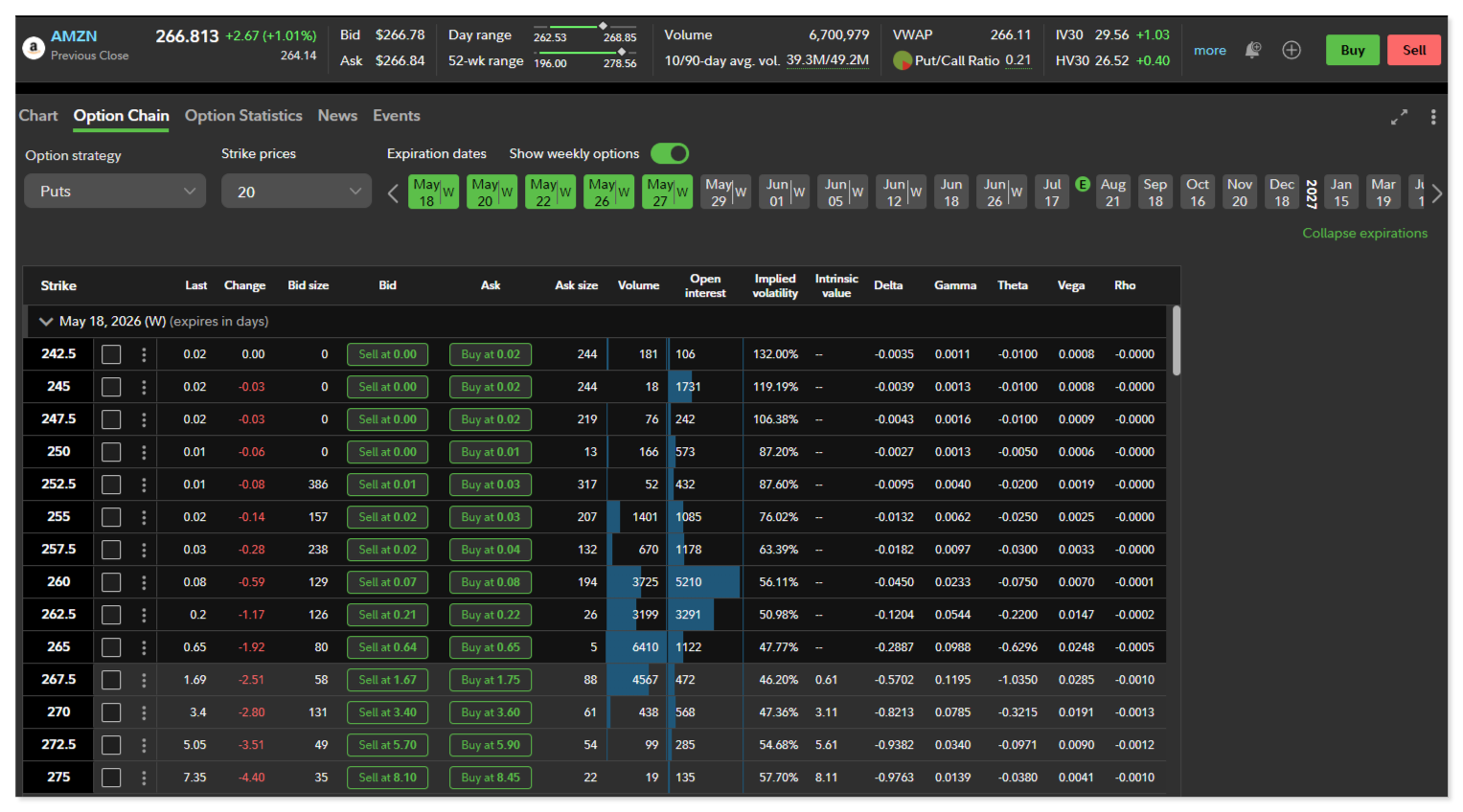
This guide explains exactly what a put option is, how it works mechanically, when it makes sense to buy one, and how the structural put data that market makers hold shapes price in ways most retail traders never see.
Most new options traders learn calls first and treat puts as an afterthought – the thing you buy when you’re feeling bearish. That framing undersells puts significantly.
Puts are also the primary hedging tool for institutional portfolios. They’re the backbone of spread strategies. And the concentration of put open interest at specific strikes – the put wall – is one of the most powerful structural forces in the market on a daily basis.
Table of Contents
- What Is a Put Option?
- Put Option Anatomy: Breaking Down a Real Contract
- How a Put Option Makes (and Loses) Money
- Puts vs. Calls: Key Differences at a Glance
- Intrinsic Value and Extrinsic Value for Puts
- Put Option Greeks You Actually Need to Know
- Types of Put Options: ITM, ATM, OTM
- When to Buy a Put Option
- Protective Puts: Using Puts as Portfolio Insurance
- Common Put Option Mistakes Beginners Make
- How Put Walls and GEX Data Change the Game
- FAQ
What Is a Put Option?

A put option is a contract that gives you the right – but not the obligation – to sell 100 shares of a stock at a specific price, before a specific date.
You pay a premium to own that right. If the stock falls below your target price before the contract expires, your put option gains value and you can sell it for a profit. If the stock stays flat or rises, the put loses value and you can lose the entire premium you paid.
The key word in the definition is sell. A call gives you the right to buy. A put gives you the right to sell. That’s the core distinction.
Just like with calls, most retail traders never actually exercise their put options – meaning they never actually sell the underlying shares. They buy the put contract, it rises in value as the stock drops, and they sell the contract itself for a profit. The actual share sale almost never happens in practice.
Put Option Anatomy: Breaking Down a Real Contract
Every put option has four components. Here’s a real example: SPY $535 Put – expiring June 20 – trading at $4.50
| Component | Value | What It Means |
|---|---|---|
| Underlying | SPY | The asset the option is tied to |
| Strike Price | $535 | The price at which you can sell SPY |
| Expiration Date | June 20 | The last day the contract is valid |
| Premium | $4.50 | What you pay per share ($450 per contract) |
Each contract covers 100 shares, so multiply the quoted premium by 100 to get your actual cost. A $4.50 premium = $450 out of pocket per contract.
The strike price ($535) is your target. SPY needs to trade below $535 for your put to have intrinsic value. The further below $535 it falls, the more your put is worth. If SPY never drops below $535 before June 20, the contract expires worthless and you lose the $450.
How a Put Option Makes (and Loses) Money
Let’s run three scenarios on the SPY $535 put purchased for $4.50 ($450 total):
Scenario A: SPY drops to $520 before expiration
Your $535 put is now deep in-the-money. The intrinsic value alone is $15.00 ($535 − $520). Add remaining time value, and the contract is trading around $16.00. You sell for a $1,150 profit on a $450 investment – a 156% return.
Scenario B: SPY drops to $532 at expiration
SPY fell below your strike, but barely. At expiration, the contract is worth exactly $3.00 ($535 − $532, zero time value left). You sell for $300 – a $150 loss despite being right on direction.
Scenario C: SPY stays at $538 through expiration
SPY never hit your strike. The contract expires worthless. You lose the full $450 premium.
The lesson from Scenario B: A directionally correct call isn’t enough. The stock has to fall far enough, fast enough. This is why strike selection matters as much as the bearish thesis itself.
Breakeven at expiration
Your breakeven price at expiration is always: Strike − Premium Paid
For this example: $535 − $4.50 = $530.50
SPY has to be below $530.50 at expiration for you to profit. Above that, you lose money – even if you’re below the strike.
Puts vs. Calls: Key Differences at a Glance
| Call Option | Put Option | |
|---|---|---|
| Right to… | Buy at the strike price | Sell at the strike price |
| Profitable when… | Stock rises above strike + premium | Stock falls below strike − premium |
| You buy when… | Bullish on the stock | Bearish on the stock, or hedging |
| Delta range | 0 to +1 | 0 to −1 |
| Max loss | Premium paid | Premium paid |
| Max gain | Unlimited (stock can rise infinitely) | Capped (stock can only go to zero) |

The maximum gain on a put is capped because a stock can only fall to zero – but a $450 investment becoming $45,000 is still very much possible in volatile market conditions.
Related: What Is a Call Option? →
Intrinsic Value and Extrinsic Value for Puts
Every put option’s premium has two parts:
Intrinsic value is what the option would be worth if it expired right now. For a put, it’s the amount the strike price exceeds the current stock price. A SPY $535 put with SPY at $528 has $7.00 of intrinsic value.
Extrinsic value (time value) is everything else – the remaining time until expiration, implied volatility expectations, and the market’s uncertainty about future price. A put trading at $10.00 with $7.00 of intrinsic value has $3.00 of extrinsic value.
Why this matters: Extrinsic value decays every single day through theta. This decay accelerates sharply in the final 7–14 days before expiration. If you’re holding a put and the stock hasn’t moved far enough, you’re bleeding value even while you wait. This catches beginners off guard more than any other mechanic.
Put Option Greeks You Actually Need to Know
Delta: How Much Your Put Moves
Delta for puts is always negative – because puts gain value when the stock falls.
- A put with delta −0.50 gains $0.50 in value for every $1 SPY drops
- ATM puts have delta ≈ −0.50
- Deep ITM puts approach delta −1.00 – they move nearly dollar-for-dollar with the stock
- Deep OTM puts have delta near −0.05 – they barely react to moderate price moves
Practical rule: For a meaningful response to a stock drop, buy puts with delta below −0.40 (i.e., delta magnitude above 0.40). OTM puts with delta of −0.10 to −0.15 need large, fast drops to show any gain.
Theta: The Daily Decay Tax
Theta is the daily dollar amount your put loses due to time passing, regardless of what the stock does. A theta of −$0.07 means your contract loses $7 per day, all else equal.
Time decay is slow early in a contract’s life and accelerates in the final 1–2 weeks. This is the most consistent way beginners lose money on puts they were eventually right about – they were right on direction but ran out of time.
Gamma: Sensitivity Acceleration
Gamma measures how fast delta changes. When a put goes from slightly OTM to ITM on a fast drop, gamma is what causes the delta to jump – making the option accelerate in value as the move extends. ATM puts near expiration have the highest gamma, which is why 0DTE puts can return multiples on a sudden intraday drop.
Vega: Implied Volatility Sensitivity
Vega measures how much your put’s value changes with a 1% change in implied volatility. Puts tend to benefit from rising IV (markets tend to get more volatile when they sell off), but buying puts after a sharp drop often means you’re buying into peak IV – which can then deflate even as the stock continues lower, capping your gains.
Types of Put Options: ITM, ATM, OTM
Where your strike sits relative to the current stock price shapes everything about how your put behaves.
| Type | Strike vs. Stock Price | Delta Range | Cost | Needs to Profit |
|---|---|---|---|---|
| In-the-Money (ITM) | Strike > current price | −0.60 to −0.99 | Higher | Modest further decline |
| At-the-Money (ATM) | Strike ≈ current price | ~−0.50 | Moderate | Moderate decline |
| Out-of-the-Money (OTM) | Strike < current price | −0.05 to −0.35 | Lowest | Large, fast decline |
ITM puts cost more but already have intrinsic value. They’re lower leverage but more forgiving – the stock doesn’t need to fall as far for you to profit.
ATM puts are the sweet spot for most directional bearish trades. They’re priced to balance leverage and probability.
OTM puts are cheap for a reason. Most expire worthless. A $0.40 put looks like a cheap lottery ticket – but it needs a sharp, fast sell-off just to get to breakeven. Used selectively as tail-risk hedges, they make sense. Used as primary trades, they’re account killers.
For beginners: Start with ATM or strikes 1–3% below the current price. Avoid puts more than 5% OTM until you have a specific reason to target that level based on GEX data.
When to Buy a Put Option
A put makes sense when you have a specific bearish thesis with a specific timeline – not a general feeling that “the market looks overextended.”
Good conditions for buying puts:
- A clear catalyst exists – earnings miss expectations, macro deterioration, a sector rotation, a specific news event with a timeline
- Implied volatility is relatively low – you’re buying cheap premium before the market panics, not after
- The stock is technically weak – below key moving averages, breaking recent support, failing to recover after a catalyst
- GEX structure supports the move – price is below the gamma flip (negative gamma regime), near a put wall that could accelerate the decline, and max pain is well below the current price
Conditions that work against you:
- IV is already elevated – you’re overpaying. A 5% drop in the stock might be offset by IV collapsing from 60% to 40%
- Less than 7 days to expiration – theta is eating your position fast. The stock needs to move immediately and substantially
- A major put wall is sitting right at or just below your strike – in positive gamma, put walls are structural support. Dealers buy shares there, preventing the decline your put needs
Protective Puts: Using Puts as Portfolio Insurance
This is the original use case for put options – and it’s still one of the most rational reasons for a retail trader to buy them.
A protective put is when you own shares of a stock and buy puts against that position to cap your downside.
Example:
You own 100 shares of QQQ at $475. You’re worried about a macro pullback but don’t want to sell your position. You buy one QQQ $460 put expiring in 45 days for $3.50 ($350 total).
If QQQ drops to $440, your shares are down $3,500 – but your put is now worth at least $2,000, offsetting most of the loss. If QQQ rises to $490, your put expires worthless and you lose the $350 premium (the cost of the insurance). Your shares gain $1,500.
Think of it as paying an insurance premium. You’re defining the worst-case outcome for your stock position. Whether that insurance is worth the cost depends on your risk tolerance, the cost of the premium relative to your position size, and your read on the current market regime.
Common Put Option Mistakes Beginners Make
Buying puts after the crash has already happened
The most common timing mistake. By the time it’s obvious the market is selling off, IV has spiked and puts are expensive. You’re paying peak premium right when the IV crush risk is highest. If the stock stabilizes or bounces, you get hit from both sides – direction and IV.
Fix: Buy puts before the move, not during it. If you think earnings are going to miss, buy the put before IV spikes. If you think a macro event will spark selling, build the position during quiet, low-IV conditions.
Buying deep OTM puts “just in case”
OTM puts feel like a bargain. They’re not. They need large, fast moves to have any value at expiration. Most retail bearish theses play out over weeks, not days – and OTM puts with short expiration don’t give you that time.
Fix: Buy closer to ATM, or go further out in expiration (45–60 days) to give the thesis time to play out while limiting theta damage.
Ignoring the put wall in positive gamma
In a positive gamma environment, a put wall doesn’t accelerate the decline – it stops it. Market makers who sold those puts must buy shares near the put wall to hedge, creating real mechanical support. Buying puts targeting a level below a major put wall in positive gamma is fighting structural buying pressure.
Fix: Check whether the market is in positive or negative gamma before buying puts. In positive gamma, put walls tend to hold. In negative gamma, they tend to break – and accelerate lower when they do.
Holding too long waiting for the move
A put is a decaying asset. Unlike a short stock position, which doesn’t decay, a put loses value every day. If your thesis is “the stock will eventually drop,” that’s not a good enough reason to hold puts. The timing has to be specific.
Fix: Define your exit before you enter. If the put is down 40–50% and the time horizon is shrinking, cut the loss. Don’t let theta finish the job.
How Put Walls and GEX Data Change the Game
A put wall is a strike price with an unusually large concentration of put open interest. It’s one of the most structurally significant levels on the GEX map – but it behaves very differently depending on the gamma regime.
In Positive Gamma: Put Walls Are Floors
When the market is in positive gamma (Net GEX is elevated, price is above the gamma flip), dealers who sold puts must buy shares of the underlying as price approaches the put wall to hedge their exposure. This creates mechanical buying support that tends to hold.
Implication for put buyers: A major put wall directly below your target is structural headwind. The put wall will absorb selling pressure and push price back up. Your put thesis needs to be strong enough to break through that mechanical buying.
In Negative Gamma: Put Walls Can Become Accelerators
When the market is in negative gamma (Net GEX is negative, price is below the gamma flip), the put wall dynamic flips. If price breaks below a major put wall, dealers must sell shares to delta-hedge their now-deeper-in-the-money short puts – adding to the selling pressure instead of absorbing it.
This is what turns an ordinary market decline into a cascade. Price breaks the put wall → dealers sell → price drops further → more puts go ITM → more dealer selling. It’s a mechanical feedback loop, and it explains why negative gamma environments can produce 3–5% intraday drops that feel completely disproportionate to the news.
For put buyers: In negative gamma environments, a break below a put wall is a signal to add or hold – not to take profit prematurely. The mechanical selling that follows a put wall break is often the biggest part of the move.
Practical Example
QQQ is at $475. You’re considering buying a $465 put. Before entering, you check SweepAlgo:
- Gamma flip at $470 – QQQ is above it, positive gamma regime
- Put wall at $468 – $190M of put open interest sitting right in your path
- Max pain for the weekly expiration: $472 – gravitational pull is actually upward from current levels
This changes the trade. In positive gamma, with max pain above current price and a major put wall between you and your strike, the structural forces are working against your put. You either skip the trade, wait for a gamma flip below $470, or go further out in expiration to give the thesis time to overcome the structural headwinds.
Now flip the scenario: QQQ is at $475, the gamma flip is at $480, QQQ is below it (negative gamma), and max pain is at $460. Now the structural forces align with the bearish thesis. Put walls in negative gamma can accelerate rather than resist the decline. That’s a very different risk/reward setup.
That’s the context a price chart cannot give you – and it’s available in real time on SweepAlgo’s GEX dashboard.
Related: How to Trade Put Walls and Call Walls Using GEX Data →
FAQ {#faq}
What is a put option in simple terms?
A put option is a contract that gives you the right to sell 100 shares of a stock at a fixed price before a set date. You pay a premium for that right. If the stock falls enough, the contract gains value and you can sell it for a profit. If it doesn’t fall far enough, you lose the premium.
Can you lose more than you invest with a put option?
No. When you buy a put, your maximum loss is the premium you paid. You cannot lose more than that. This is a key advantage over short-selling a stock, where losses are theoretically unlimited.
How is buying a put different from short-selling?
Short-selling a stock means borrowing shares and selling them, hoping to buy them back cheaper later. It requires a margin account, has unlimited downside risk if the stock rises, and involves borrow costs. Buying a put risks only the premium paid, requires no margin (for long puts), and has a defined expiration. Puts are a cleaner, more controlled way to express a bearish view for most retail traders.
What happens to a put option when it expires?
If the stock is below the strike price at expiration, the put has intrinsic value and is exercised (or sold before expiration). If the stock is above the strike, the put expires worthless and you lose the premium paid.
What is a good delta for a put option?
For most directional bearish trades, a delta between −0.40 and −0.60 (ATM to slightly OTM) is the right starting point. It gives you meaningful leverage without requiring a crash to profit. Deep OTM puts with delta above −0.20 (magnitude) need large, fast drops to become profitable and expire worthless the vast majority of the time.
What is a protective put?
A protective put is when you own a stock and buy puts against that position to limit your downside. If the stock falls sharply, the put gains value and offsets losses on the shares. It’s essentially portfolio insurance – you pay a premium (the put cost) to define your worst-case outcome.
How does the gamma regime affect put options?
In positive gamma environments, market makers buy shares near put walls, creating support and working against put buyers targeting those levels. In negative gamma environments, dealer hedging amplifies declines – put walls can break and accelerate lower rather than hold. Knowing the gamma regime before buying puts is one of the highest-value adjustments a beginner can make.
When should I buy a put instead of shorting the stock?
For most retail traders, almost always. Puts define your risk (you can only lose the premium), don’t require a margin account, don’t have borrow costs, and don’t expose you to unlimited loss if the stock squeezes higher. The trade-off is that puts expire – so timing matters more than with a short stock position.
The Bottom Line
A put option gives you leveraged, capped-risk exposure to a bearish move in a stock – or a clean way to hedge a long position you don’t want to sell. The mechanics mirror calls almost exactly, with one critical difference: the structural forces that govern puts (put walls, the gamma regime) behave very differently depending on whether the market is in positive or negative gamma.
Understanding those forces before you enter a put trade is the difference between fighting mechanical headwinds and trading with them. That’s what GEX data gives you – and it’s why checking SweepAlgo’s dashboard before placing any directional put trade is one of the simplest habits a new options trader can build.
See real-time put walls and GEX levels for SPY, SPX, and QQQ on SweepAlgo →
No contracts. Cancel anytime.
Disclaimer: This content is for educational purposes only and does not constitute financial advice. Options trading involves substantial risk of loss and is not appropriate for all investors.