

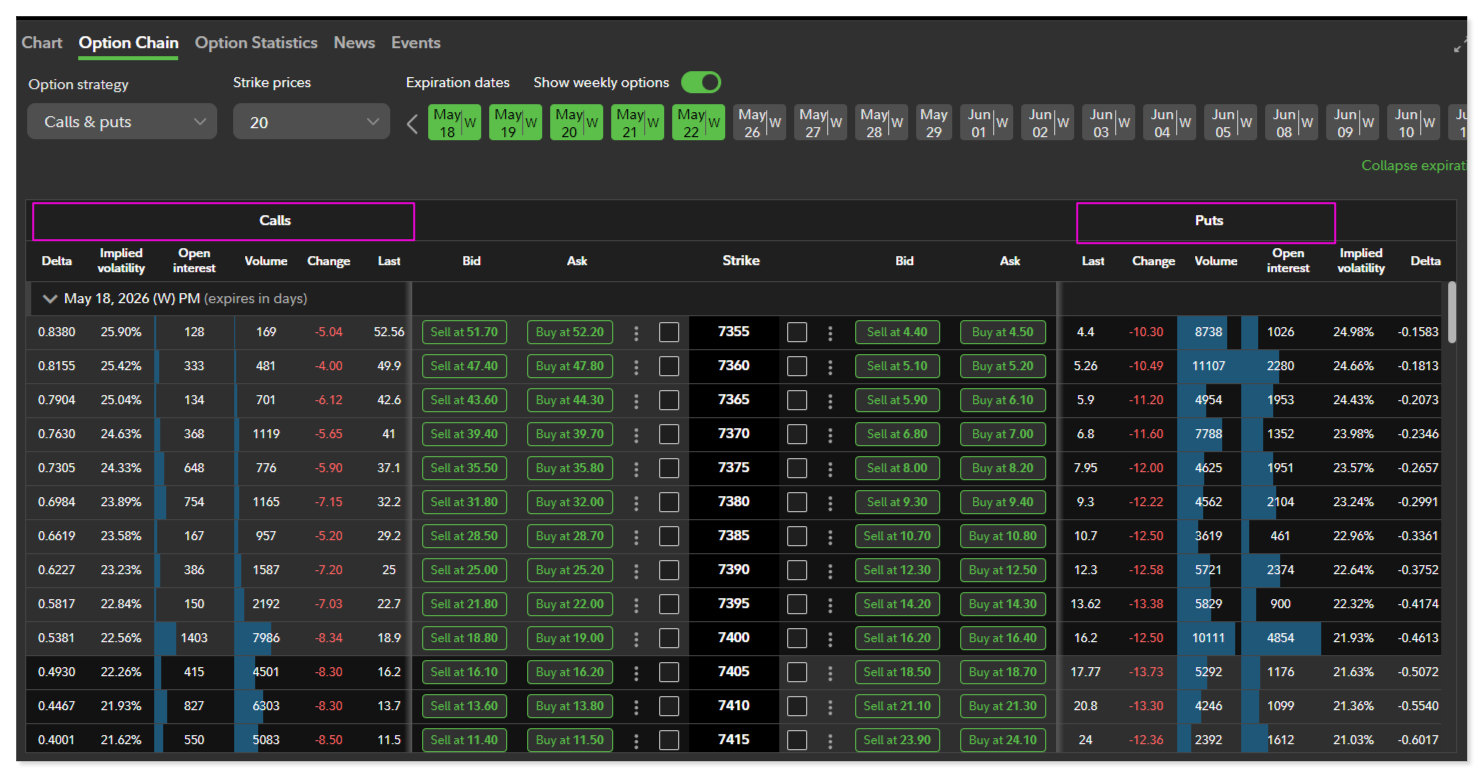
This guide explains exactly what a call option is, how it works mechanically, how to read one, and – critically – what the beginner playbook gets wrong. If you already know what stocks are but have never placed an options trade, you’re in the right place.
Most traders hear “call option” and picture someone making a bet that a stock goes up. That’s partially right. But if that’s all you understand, you’ll consistently overpay, buy at the wrong time, and lose money on trades where you correctly predicted the direction.
Table of Contents
- What Is a Call Option?
- Call Option Anatomy: Breaking Down a Real Contract
- How a Call Option Makes (and Loses) Money
- Intrinsic Value vs. Extrinsic Value
- Call Option Greeks You Actually Need to Know
- Types of Call Options: ITM, ATM, OTM
- When to Buy a Call Option
- Common Call Option Mistakes Beginners Make
- How GEX Call Walls Change the Game
- FAQ
What Is a Call Option?
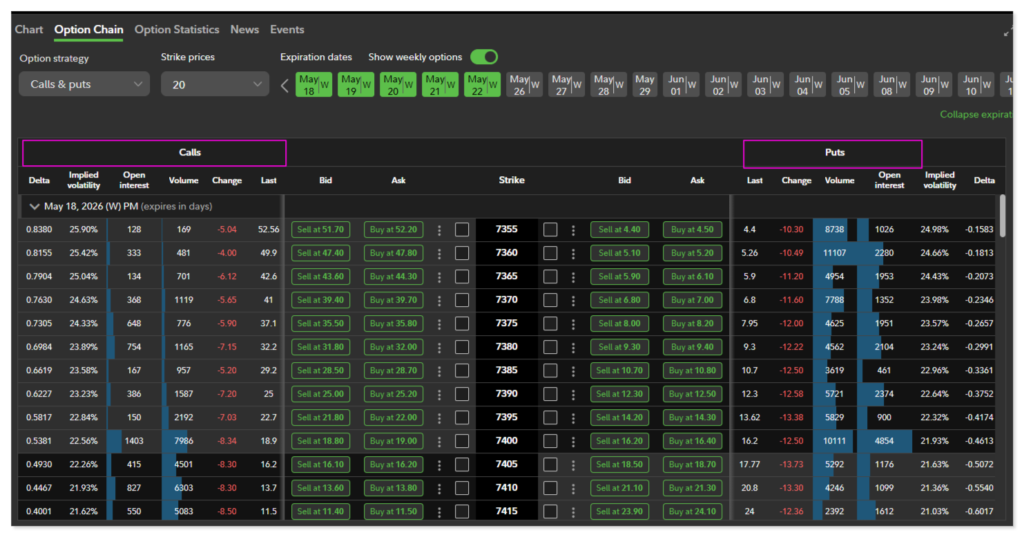
A call option is a contract that gives you the right – but not the obligation – to buy 100 shares of a stock at a specific price, before a specific date.
You pay a fee (called the premium) to own that right. If the stock rises above your target price before the contract expires, your call option gains value and you can sell it for a profit. If the stock doesn’t move enough, or moves in the wrong direction, you can lose the entire premium you paid.
That’s the core mechanic. Everything else – delta, strike selection, expiration timing – is just a layer on top of that.
One thing to understand from the start: most retail traders never actually exercise their call options (i.e., they never actually buy the 100 shares). They buy the call contract, it rises in value as the stock moves up, and then they sell the contract itself for a profit – the same way you’d sell a stock. The actual share purchase almost never happens.
Call Option Anatomy: Breaking Down a Real Contract
Every call option has four components. Before you buy one, you need to understand all four.
Here’s a real example: SPY $545 Call – expiring June 20 – trading at $4.20
| Component | Value | What It Means |
|---|---|---|
| Underlying | SPY | The asset the option is tied to |
| Strike Price | $545 | The price at which you can buy SPY |
| Expiration Date | June 20 | The last day the contract is valid |
| Premium | $4.20 | What you pay per share ($420 per contract) |
Each contract covers 100 shares, so the true cost is always premium × 100. A $4.20 premium = $420 out of pocket per contract.
The strike price ($545) is your target. SPY needs to trade above $545 for your call to have intrinsic value. The further above $545 it goes, the more your call is worth. If SPY never reaches $545 before June 20, the contract expires worthless and you lose the $420.
How a Call Option Makes (and Loses) Money
Let’s run three scenarios on the SPY $545 call purchased for $4.20 ($420 total):
Scenario A: SPY rallies to $558 before expiration
Your $545 call is now deep in-the-money. The intrinsic value alone is $13.00 ($558 − $545). Add remaining time value, and the contract is trading around $14.50. You sell for a $1,030 profit on a $420 investment – a 145% return.
Scenario B: SPY rises to $547 at expiration
SPY made it above your strike, but barely. At expiration, the contract is worth exactly $2.00 ($547 − $545 intrinsic value, zero time value left). You sell for $200 – a $220 loss despite being right on direction.
Scenario C: SPY stays at $541 through expiration
SPY never hit your strike. The contract expires worthless. You lose the full $420 premium.
The key lesson from Scenario B: being directionally correct is not enough. The stock has to move far enough, fast enough, for your call to be profitable. This is why strike selection and timing matter as much as the directional call itself.
Breakeven at expiration
Your breakeven price at expiration is always: Strike + Premium Paid
For the SPY example: $545 + $4.20 = $549.20
SPY has to be above $549.20 at expiration for you to profit. Below that, you lose money – even if you’re above the strike.
Intrinsic Value vs. Extrinsic Value
Every call option premium has two parts:
Intrinsic value is what the option would be worth if it expired right now. It’s the amount the stock price exceeds the strike price. A SPY $545 call with SPY at $550 has $5.00 of intrinsic value.
Extrinsic value (also called time value) is everything else. It reflects how much time is left, how volatile the stock is, and the market’s expectation of future movement. A SPY $545 call trading at $7.00 with $5.00 of intrinsic value has $2.00 of extrinsic value.
Why this matters: Extrinsic value decays every day. As expiration approaches, time value bleeds out regardless of what the stock does. This decay (called theta) is the most underestimated force in options – and it works against every buyer, every day.
Call Option Greeks You Actually Need to Know
You don’t need to memorize all five Greeks to trade calls effectively. You need three.
Delta: How Much Your Call Moves
Delta tells you how much your option’s price changes for every $1 move in the stock.
- A call with delta 0.50 gains $0.50 in value for every $1 SPY rises
- ATM options (strike = current price) have delta ≈ 0.50
- Deep ITM calls approach delta 1.00 – they move nearly dollar-for-dollar with the stock
- Deep OTM calls have delta near 0.05–0.10 – they barely move at all
Practical rule: If you want your call to react meaningfully to a stock move, buy options with delta above 0.40. OTM calls with delta below 0.20 need large, fast moves just to show a gain.
Theta: The Daily Decay Tax
Theta is the daily dollar amount your call loses due to time passing. A theta of -$0.08 means your contract loses $8 per day, all else equal.
Theta is slow early in a contract’s life and accelerates in the final 7–14 days. Holding a call into the last week before expiration – especially OTM – is expensive. This is one of the most common ways beginners lose money on trades where they were eventually right.
Gamma: The Acceleration Factor
Gamma measures how fast delta changes. High gamma means your call becomes much more (or less) valuable as the stock moves. ATM calls near expiration have the highest gamma – which is why 0DTE (zero days to expiration) options move so violently.
Gamma is also what drives the structural market forces (call walls, gamma flips) that SweepAlgo measures. Understanding gamma at the individual contract level and at the market-wide level are two different things – and both matter.
Types of Call Options: ITM, ATM, OTM
Where your strike sits relative to the current stock price dramatically changes how your call behaves.
| Type | Strike vs. Stock Price | Delta Range | Cost | Needs |
|---|---|---|---|---|
| In-the-Money (ITM) | Strike < current price | 0.60–0.99 | Higher | Less movement to profit |
| At-the-Money (ATM) | Strike ≈ current price | ~0.50 | Moderate | Moderate movement |
| Out-of-the-Money (OTM) | Strike > current price | 0.05–0.35 | Lowest | Large movement to profit |
ITM calls are more expensive but behave more like the stock. Less leverage, more reliability.
ATM calls are the sweet spot for most directional trades. Balanced leverage, responsive to moves.
OTM calls are cheap for a reason. They’re priced to reflect how unlikely it is that the stock reaches that strike in time. Most OTM calls expire worthless. Buying them repeatedly is one of the fastest ways to drain an account.
For beginners: Start with ATM or slightly OTM (within 1–2% of current price). Avoid strikes more than 3–5% away from current price until you have a clear reason to target that specific level.
When to Buy a Call Option
A call option makes sense when you have a specific bullish thesis on a specific timeframe. Not “I think this stock is going up eventually” – but “I think this stock moves above $X within the next Y days, and here’s why.”
Good conditions for buying calls:
- You have a clear catalyst – earnings, product launch, macro event – with a specific timeline
- Implied volatility is relatively low, meaning premiums are cheap (you’re not overpaying for time value)
- You want leveraged upside with capped downside – you’re willing to lose the entire premium, but can’t lose more than that
- The stock is trending above key GEX support levels, suggesting structural tailwinds
Conditions that work against you:
- Implied volatility is elevated – you’re paying inflated premiums that will deflate even if you’re right
- Expiration is less than 7 days away – theta decay is accelerating and working against you fast
- You’re buying deep OTM – the stock needs a large, fast move just to get to breakeven
- A major call wall is sitting right at or just above your strike – dealer hedging creates structural resistance that can cap the move
Common Call Option Mistakes Beginners Make
Buying too far OTM
The lottery ticket problem. A $0.30 call looks cheap. But it needs a large, fast move just to avoid expiring at $0. These contracts expire worthless at a rate above 80% in most market conditions. Cheap isn’t the same as good value.
Ignoring IV (Implied Volatility)
Buying options when IV is high means you’re paying a premium for volatility expectations that may already be priced in. If the stock moves exactly as predicted but IV drops – which it does after earnings – you can still lose money. Always check IV rank before buying.
Holding into expiration hoping for a recovery
Options are not stocks. If your call is down 60% and has 4 days left, theta is now working against you hard. The stock doesn’t just need to recover – it needs to recover fast enough to offset decay. Cut losses earlier than feels natural.
Buying calls into a structural resistance zone
This one is invisible if you’re only looking at price charts. If there’s a massive call wall just above your strike – a strike where market makers hold enormous call exposure and must sell into rallies – your call is fighting mechanical selling pressure from the start. You need to know where those levels are before you enter.
How GEX Call Walls Change the Game
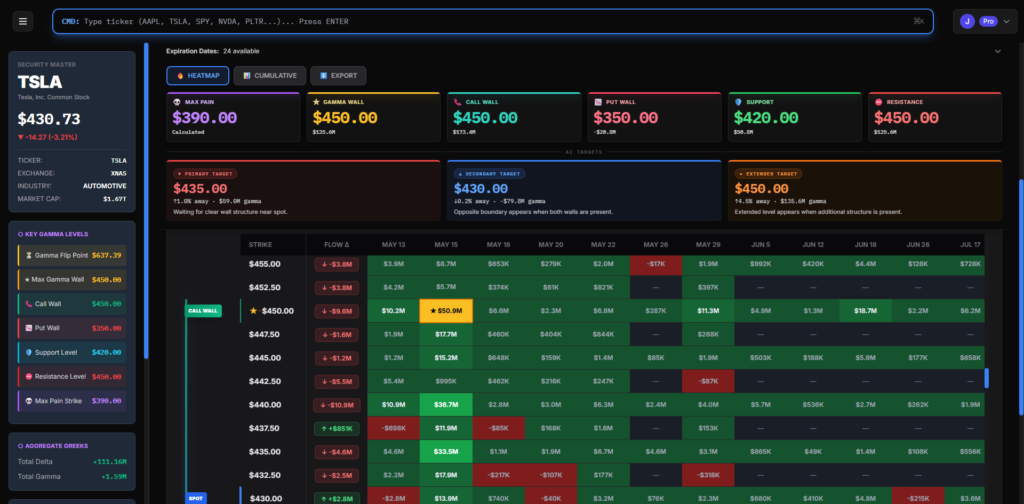
A call wall is a strike price with an unusually large concentration of call open interest. When price approaches a call wall, market makers who sold those calls must sell shares of the underlying to hedge – creating mechanical selling pressure at that level.
For a call buyer, this is critical information.
Example:
SPY is at $540. You’re considering the $545 call. Before you place the order, you check SweepAlgo and see a massive call wall at $543 – $280M of open interest concentrated right there.
That call wall is a structural ceiling between your entry and your strike. Every time SPY rallies toward $543, dealer hedging creates automatic selling pressure. Your call can be directionally correct – SPY does want to move higher – but the gamma mechanics are working against it reaching your strike cleanly.
This is information a price chart cannot give you. It requires seeing the actual options positioning data – which is exactly what SweepAlgo’s GEX heatmap shows in real time.
Using GEX before buying a call:
- Check the gamma flip – is SPY/QQQ in positive or negative gamma? Positive gamma means controlled, range-bound conditions. Negative gamma means amplified moves in either direction.
- Identify call walls between current price and your strike – these are your structural headwinds.
- Check max pain – if price has gravitational pull toward max pain and it’s below your strike, that’s a headwind too.
- Read the AI analysis – SweepAlgo’s plain-English regime label tells you in one line whether the structure supports or fights your trade.
Related: How to Trade Put Walls and Call Walls Using GEX Data →
FAQ
What is a call option in simple terms?
A call option is a contract that gives you the right to buy 100 shares of a stock at a fixed price before a set date. You pay a premium for that right. If the stock rises enough, the contract gains value and you can sell it for a profit. If it doesn’t, you lose the premium.
Can you lose more than you invest with a call option?
No. When you buy a call, your maximum loss is the premium you paid. You cannot lose more than that. This is one of the key differences between buying options and other leveraged instruments like futures or margin trading.
What happens to a call option when it expires?
If the stock is above the strike price at expiration, the call has intrinsic value and is exercised (or sold). If the stock is below the strike price, the call expires worthless and you lose the premium paid.
Is buying a call option the same as buying stock?
No. Buying a call gives you the right to buy stock, not ownership of it. You don’t receive dividends, you don’t have voting rights, and the contract has an expiration date. The key advantage of a call over the stock is leverage: a smaller amount of capital controls exposure to 100 shares.
What is a good delta for a call option?
For most directional trades, a delta between 0.40 and 0.60 (ATM to slightly OTM) is the right starting point. It gives you meaningful leverage without requiring an extreme price move to profit. Deep OTM calls with delta below 0.20 require large, fast moves to become profitable and expire worthless the majority of the time.
How do call walls affect a call option I’m buying?
A call wall is a strike with large concentrated call open interest. Market makers who sold those calls must hedge by selling shares as price approaches the wall, creating resistance. If your strike is near or beyond a major call wall, you’re buying into structural headwinds. Always check GEX levels before selecting your strike.
When is the best time to buy call options?
When implied volatility is relatively low (you’re not overpaying for time value), you have a clear directional catalyst with a specific timeline, and the GEX structure supports an upward move without major call walls blocking the path to your strike.
The Bottom Line
A call option gives you leveraged, capped-risk exposure to a bullish move in a stock. The mechanics are simple. What gets beginners in trouble isn’t the concept – it’s strike selection, timing, ignoring IV, and entering trades without knowing where the structural resistance actually is.
Understanding GEX data – specifically call walls, gamma flips, and the overall gamma regime – closes that blind spot. You’re not just picking a direction. You’re picking a direction with a structural map of where the market’s mechanics will work for or against your trade.
See real-time call walls and GEX levels for SPY, SPX, and QQQ on SweepAlgo →
No contracts. Cancel anytime.
Disclaimer: This content is for educational purposes only and does not constitute financial advice. Options trading involves substantial risk of loss and is not appropriate for all investors.